Sealed Quench Furnace
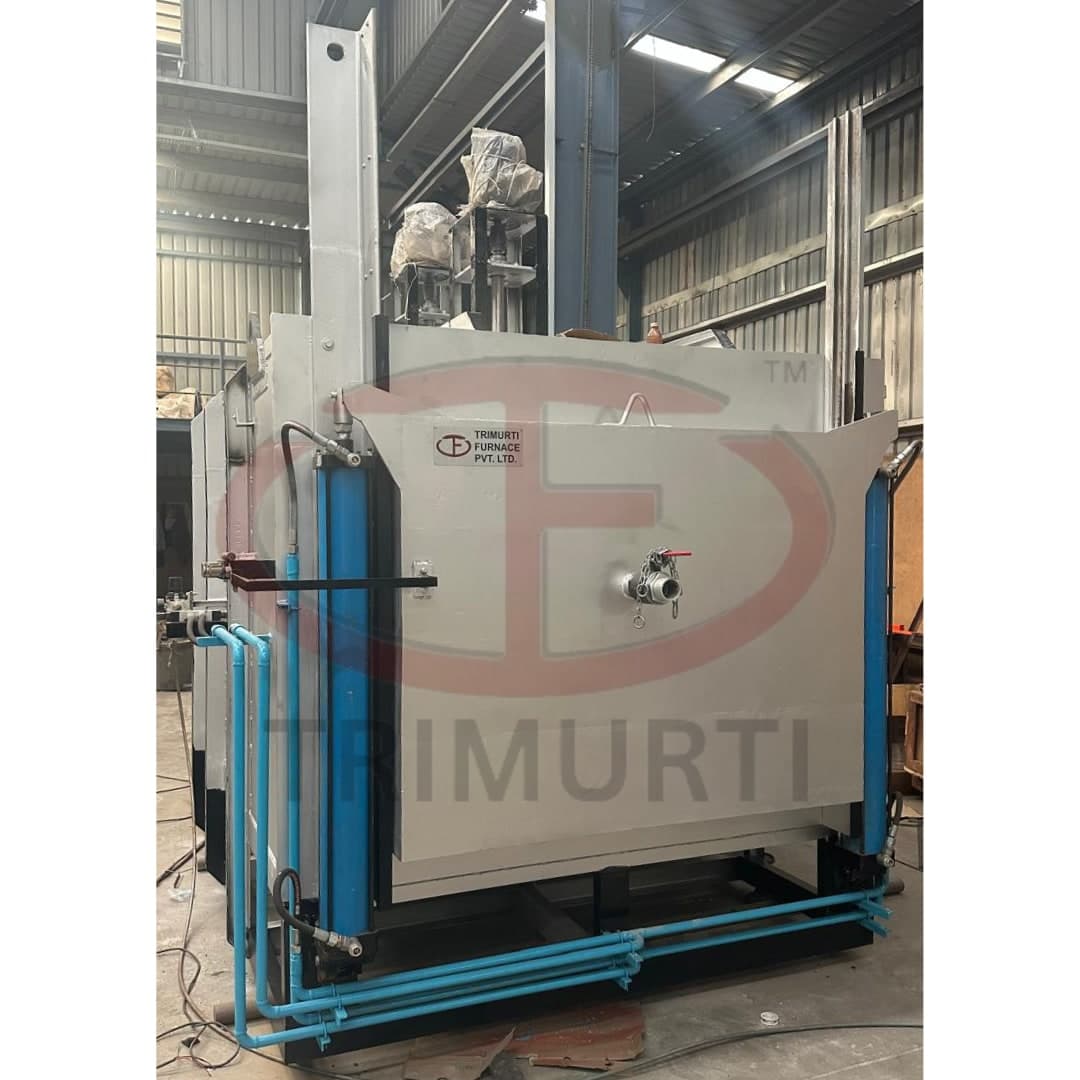
A fully automatic, straight-through sealed quench furnace. The charge is heated, carburised and oil-quenched without leaving the protective atmosphere, all run from a PLC with optional SCADA.
Also known as: Integral quench furnace, IQ furnace, Sealed quench carburizing furnace
Overview
The Sealed Quench Furnace is designed and built by Trimurti Furnace in Nashik, India, for carburising & carburising-hardening, carbonitriding & hardening, bright annealing and controlled-atmosphere annealing. It is offered with a loading capacity of 1500 kg and a maximum temperature of 950 °C. Capacity can be changed as per your requirement. Each furnace is engineered to the customer's parts and throughput by Trimurti Furnace Pvt. Ltd., an ISO 9001-certified manufacturer since 1991.
Fully automatic, straight-through sealed quench furnace, electrically heated through radiant tubes. The charge is heated, carburised and oil-quenched without ever leaving the protective atmosphere, and the whole cycle runs from a PLC with an optional SCADA system. Supplied on its own or as a complete line with a tempering furnace, a two-stage washing machine, traversers and a charge stock conveyor.
Engineering Perspective
Our flagship. The part never sees air between heat and quench.
The integral oil-quench tank is the whole point: from austenitising temperature to oil-quench, the part stays inside controlled atmosphere. That eliminates the decarb and oxide that plague open-air heat treatment — and it's why automotive and forging customers specify this furnace by name.
- Integral quench: no atmosphere exposure during transfer
- 1500 kg charge, fully automated cycle
- Six process modes from one machine
- Engineered, tested, and signed off with your parts
The Process
From load to quench
The part never meets open air between heating and quenching. Five steps, all inside the protective atmosphere.
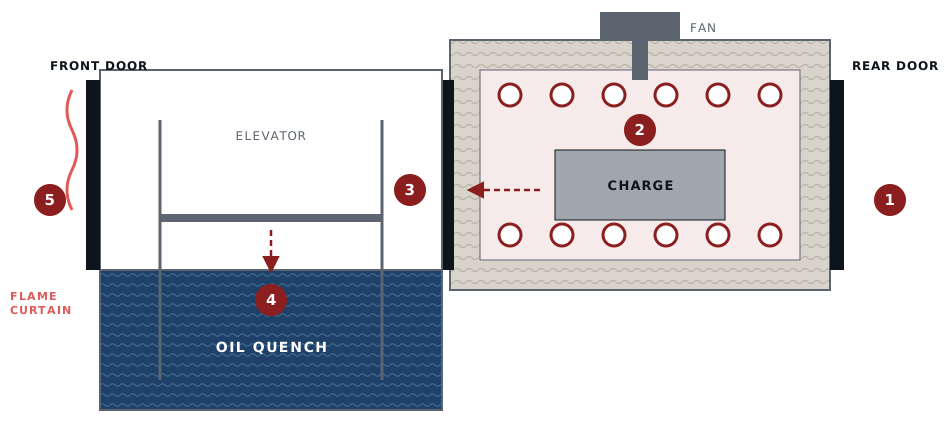
- 01
Load
The charge enters the heating chamber through the rear door.
- 02
Heat & carburise
Radiant tubes heat the charge in a controlled gas atmosphere. A fan keeps the heat even.
- 03
Transfer
The inner door opens and the charge moves into the front chamber, still inside the protective gas.
- 04
Quench
The elevator lowers the charge straight into moving oil.
- 05
Unload
The charge comes out through the front door, protected by a flame curtain.
Why it matters
Sealed quench
Exposure to air between furnace and quench causes scale and soft spots. Here the part never sees air, so it comes out clean, with even hardness.
Atmosphere control
Carburising adds carbon to the surface so it becomes hard and wear-resistant, while the core stays tough. Accurate gas control gives the same case depth every time.
Control & traceability
Every load is traceable, which customers' quality audits ask for. Safety alarms stop problems before they damage the furnace or the parts.
Complete Line
Supplied with it
Tempering furnace
Makes hardened parts tough enough to use.
Two-stage washer
Removes oil after quenching.
Traversers
Move charges between machines.
Charge conveyor
Holds loads ready for the next cycle.
Applications
Built for these processes
- Carburising & carburising-hardening
- Carbonitriding & hardening
- Bright annealing
- Controlled-atmosphere annealing
- Normalising
- Re-carburising
- Gears
- Shafts
- Fasteners
- Bearings
- Axle parts
- Forgings
- Castings
- Tools
Key Features
What sets it apart
- Integral oil quench: no air exposure during transfer
- Automatic charging and discharging by motor-driven forks
- The next charge is loaded while the previous one is being quenched
- Pilot burners and flame curtains at the doors keep outside air out
- Automatic burn-off (de-sooting) at the end of every cycle
- Draft-tube oil agitation with variable-speed drive and water-cooled heat exchanger
- Alarms for over-temperature, pusher overload and circulation-fan failure
- Independent over-temperature controller and duplex thermocouples
- SCADA logs time, temperature, carbon potential and agitator speed for every load
Questions
Sealed Quench Furnace — FAQ
Who manufactures the Sealed Quench Furnace in India?
Trimurti Furnace Pvt. Ltd. designs and manufactures the Sealed Quench Furnace in-house at its works in Ambad MIDC, Nashik, with a further plant at MIDC Chakan, Pune, Maharashtra. The company has built industrial furnaces since 1991, is ISO 9001 certified and has exported furnaces since 2005.
What else is the Sealed Quench Furnace called?
It is also known as integral quench furnace, IQ furnace and sealed quench carburizing furnace. Trimurti Furnace builds it in Nashik, India.
What loading capacity does the Trimurti Sealed Quench Furnace handle?
1500 kg. Capacity can be changed as per your requirement. Chamber size and heating load are engineered to each customer's parts and throughput.
What is the maximum temperature of the Sealed Quench Furnace?
Maximum working temperature: 950 °C.
What is the Sealed Quench Furnace used for?
It is used for carburising & carburising-hardening, carbonitriding & hardening, bright annealing, controlled-atmosphere annealing, normalising and re-carburising, and is part of Trimurti Furnace's range of heat-treatment furnaces.
How is the Sealed Quench Furnace heated?
Electric radiant tubes (SS 310) with Ni-Cr 80/20 elements.
How long does delivery of the Sealed Quench Furnace take?
5 – 6 months (complete line), counted from an order that is technically and commercially clear.
Does Trimurti Furnace provide installation, service and spares for the Sealed Quench Furnace?
Yes. Every furnace is installed and commissioned by Trimurti engineers, with operator training and annual maintenance contracts. Spares such as heating elements, radiant tubes, thermocouples, oxygen probes, retorts, mesh belts and refractory are supplied for furnaces already in service.
How do I get a quotation for the Sealed Quench Furnace?
Send an enquiry through the website, call or WhatsApp +91 91300 53323, or email info@trimurtifurnace.com. Share your parts, material, process and throughput, and Trimurti's engineers respond within one working day.
Same Category